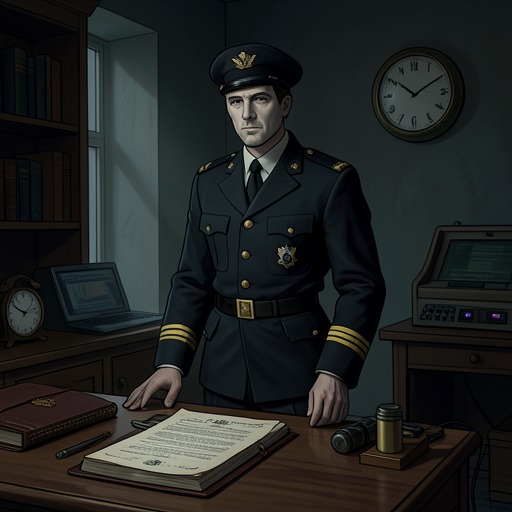
Circle of Compliance
The Caine Mutiny Court-MartialThe Circle of Compliance is the informal boundary around Captain Queeg within which the crew of the USS Caine observed his rules. Its reach followed the range of his eyes and ears: in view of the captain, orders were obeyed; beyond that range, the ship’s older, looser routines persisted. The pattern was neither a coordinated mutiny nor proof that the rules had won the crew’s allegiance. It was a practical accommodation to a demanding command, maintained by surveillance and the threat of punishment but limited by the difficulty of enforcing every order throughout an overworked ship.
How the Circle Worked
A cigarette butt in a forecastle scupper led Queeg to cancel liberty for the entire crew. The posted order produced visible effort: the deck force kept the main deck swept over the following days. But when the Caine sailed for Kwajalein, the order was shelved and the deck returned to its previous condition apart from scheduled sweeping. One sailor remained assigned to clean a narrow stretch between Queeg’s cabin, the bridge ladder, and the wardroom hatchway. The contrast made the boundary concrete: attention was concentrated along paths the captain used, rather than spread evenly across the ship.
The crew had learned Queeg’s habits and routes, so his authority operated unevenly. When he unexpectedly moved outside his usual circuit, disorder or disagreement could draw a new rule on the spot. Sailors then observed that edict within the captain’s reach, while it went disregarded elsewhere. This was described not as a deliberate conspiracy but as a pattern that individual crew members might not themselves have recognized or accepted as a shared arrangement. Compliance arose from repeated encounters with the captain and the immediate consequences of being noticed, not from a single collective plan.
The Ship Beyond the Captain’s Reach
Outside the circle, the Caine remained an untidy and comparatively lawless ship. Its sailors relied on informal rules within their own community, and some preferred Queeg precisely because keeping out of his sight allowed them to sleep late, gamble, or enjoy the disorder he did not observe. The crew’s response was not uniform: general dislike coexisted with sharper hostility among those who had clashed with him, while some sailors judged his command tolerable on the condition that they avoided his attention.
The divide could also shape whom sailors supported. Stilwell was widely understood to be a particular target of Queeg’s dislike, and his anxiety about an unresolved family matter intensified while he waited for news. Sailors opposed to Queeg tried to encourage him, drawing some of the opposition toward Stilwell; others kept their distance for fear that the captain might extend his displeasure to Stilwell’s associates. The circle thus affected more than the observance of posted orders: Queeg’s attention could influence the crew’s relationships and their sense of who was safe to stand beside.
Maryk and the Officers’ Two Worlds
Steve Maryk occupied an uneasy position between official discipline and the ship’s practical needs. As executive officer, he knew that enforcing the captain’s rules was his responsibility. He also judged many of them impossible to apply to an overworked, overcrowded crew, or enforceable only at a cost to the Caine’s already narrow margin of seaworthiness. Rather than attempt to impose every order everywhere, Maryk tacitly accommodated the crew’s limited compliance and concentrated on keeping the ship functioning outside the captain’s immediate sphere.
A later confrontation over a docking accident shows how sharply the formal chain of command could press against that judgment. Queeg ordered the entire crew deprived of two days’ leave, blaming the after line-handling party. Maryk objected that the penalty was severe and that the crew had faced difficult circumstances. Queeg asserted his authority and threatened to extend the punishment to the officers; Maryk then relayed the order. He also faced Queeg’s warning that his protest would count as insubordination and affect his fitness report. The episode does not erase the difference between formal obedience and the crew’s everyday accommodations: it shows that when Queeg directly demanded compliance, even Maryk’s resistance had limits.
The wardroom reflected the same division. Queeg became increasingly isolated; Maryk maintained what contact remained between captain and ship, but otherwise retreated into silence. The other officers, led in their joking by Tom Keefer, turned their dislike of Queeg into a bond and mocked him for hours. Willie Keith, treated as Queeg’s favored officer, joined in the satire despite the captain’s warmer manner toward him. Maryk alone refrained, either remaining silent, defending Queeg, or leaving when the ridicule continued. The wardroom therefore contained its own competing responses to the captain: accommodation, resentment, comic resistance, and a refusal to join in.
Enforcement, Evasion, and Breakdown
The crew’s practices became especially visible when Queeg’s restrictions met immediate physical need. During oppressive conditions aboard the ship, sailors began obtaining water from the engine room despite his ban on personal water use. The news spread through the Caine, and the ladders to the engine space became crowded. When Paynter reported the activity to Maryk, the executive officer avoided engaging directly with the report. The officers, although hostile to Queeg in other respects, did not follow the sailors down to obtain water; an officer’s cap still carried a sense of obligation that the crew’s actions did not share. The incident reveals that resistance to an order could be widespread without becoming a formal challenge to the captain’s authority.
A shipwide search for a missing item showed the reverse condition: once Queeg withdrew, enforcement weakened. Maryk continued the search, but the crew and petty officers soon sensed a change. Their effort slackened into perfunctory motions, and by midday the search had become an embarrassment to the officers and a source of amusement to the sailors. Maryk ended it after accepting reports that each section had completed its assignment. Queeg later treated the failure to find the item as confirmation of his low opinion of his subordinates. The episode exposed the instability of an order whose practical force depended so heavily on the captain’s presence.
Significance
The Circle of Compliance gives a name to the distance between command on paper and discipline in daily life. Queeg could make rules, impose collective penalties, and demand obedience, but the crew’s conduct remained shaped by his visibility, the ship’s working conditions, informal sailor customs, and Maryk’s assessment of what could safely be enforced. The result was not simply order opposed by disorder: it was a layered system in which official commands and unofficial routines operated side by side.
That arrangement also helps explain why the Caine could appear disciplined in the captain’s presence while remaining substantially unchanged elsewhere. The narrow patch kept clean, the shelved order, the sailors’ private access to water, and the faltering search all show authority working most effectively where it could be seen—and losing force when supervision receded. Maryk’s role was to manage that gap, preserving the ship’s operation without either fully enforcing Queeg’s rules or openly replacing them. The circle’s significance lies in that unstable compromise between the authority of the captain and the practical life of the crew.